Narrative Bridges: How Scene Transitions Guide Audience Investment Across Award Contenders

Scene transitions function as narrative bridges in contemporary cinema, linking disparate moments while sustaining viewer engagement across extended runtimes in award-contending releases. Data from major festivals indicate that films employing deliberate transition strategies often maintain higher audience retention rates through the second and third acts, where many productions experience measurable drop-offs in attention metrics. Researchers at institutions such as the University of Southern California have documented how these connective devices operate on both cognitive and emotional levels, guiding spectators from one narrative unit to the next without breaking immersion.
Core Mechanisms of Narrative Continuity
Editors rely on several established techniques to create these bridges, including straight cuts that preserve temporal flow, dissolves that signal temporal or emotional shifts, and match cuts that align visual elements across scenes to imply thematic connections. In award contenders screened during the 2025-2026 cycle, these methods appear with increasing frequency as directors seek to balance complex storylines with accessible pacing. Observers note that productions utilizing match cuts frequently achieve tighter audience investment because the visual echo reinforces character motivations without requiring additional exposition.
Sound design often works in tandem with visual transitions, carrying ambient tones or musical motifs across the edit point to smooth the perceptual jump. Industry reports compiled by the European Audiovisual Observatory show that films incorporating consistent audio layering across transitions demonstrate stronger completion rates in test screenings compared with those relying solely on abrupt cuts. This integration becomes especially relevant in ensemble dramas and historical epics that dominate awards shortlists, where multiple character arcs must converge without disorienting viewers.
Patterns in Recent Award-Season Releases
Analysis of titles positioning themselves for the 2026 Academy Awards reveals recurring patterns in transition usage. Productions that interweave parallel storylines employ rhythmic cutting patterns to maintain momentum, alternating between locations or time periods while preserving emotional continuity. One notable example involves a historical drama that used brief, rhythmic dissolves to compress months of character development into sequences that still felt immediate to audiences.
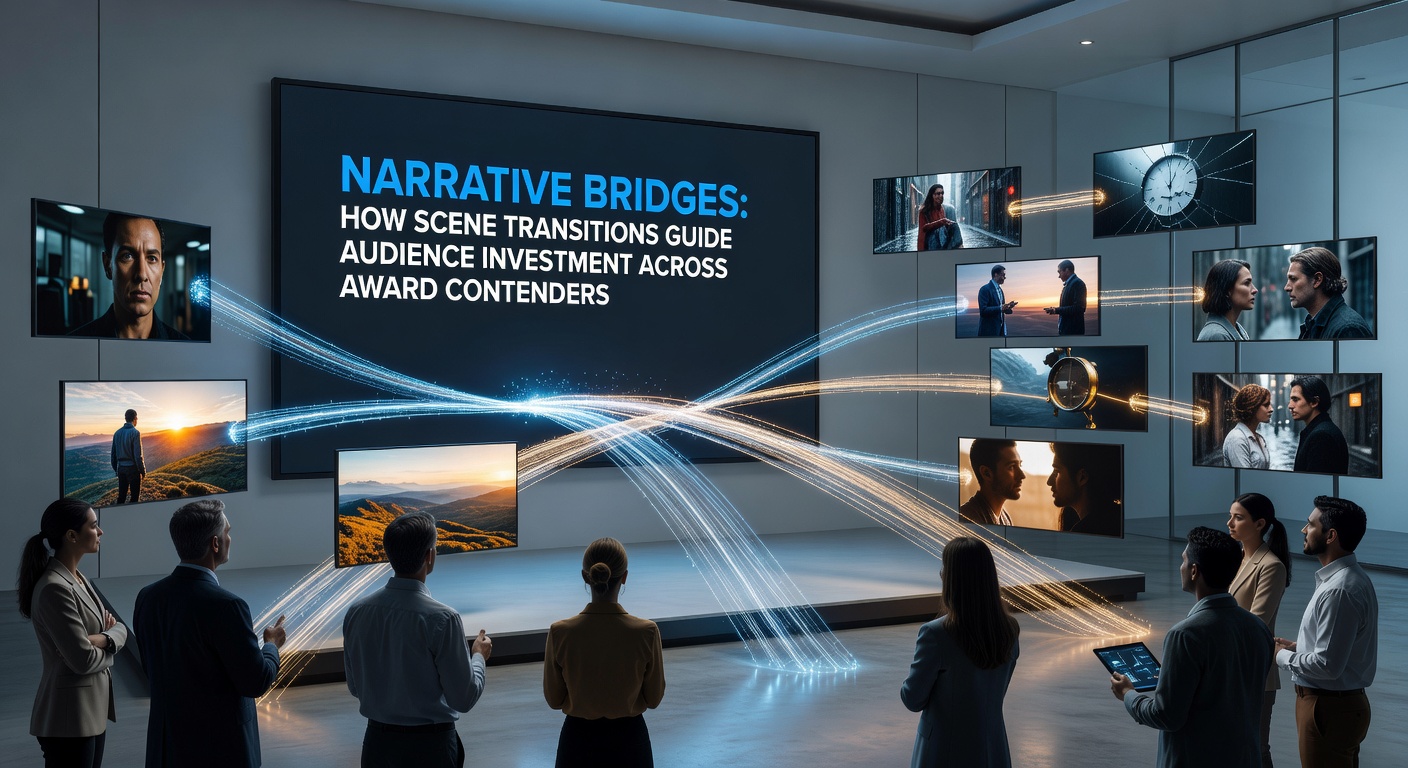
Cross-cutting between simultaneous events appears in several action-dramas competing for attention in May 2026 festival circuits, where editors synchronize tension across locations through precisely timed cuts. Data collected during preview screenings indicate that audiences report higher emotional investment when these transitions maintain consistent pacing rather than accelerating or decelerating abruptly. Festival programmers have observed that such techniques help multi-threaded narratives compete effectively against more linear competitors in awards voting.
Measurement of Audience Engagement
Quantitative studies conducted by film research centers track eye movement, heart rate, and self-reported engagement during transition moments. Findings indicate that well-executed bridges reduce cognitive load, allowing viewers to remain focused on character stakes rather than reorienting after each scene change. Productions recognized by bodies such as the British Film Institute frequently demonstrate these characteristics in their editing choices, correlating with sustained box-office performance through awards season.
Editors working on current contenders describe transition decisions as part of the larger architecture of pacing, where each cut or dissolve serves both story and viewer psychology. When transitions align with thematic motifs, such as recurring visual elements that echo across scenes, audience surveys show increased recall of key plot points weeks after viewing. This retention matters for awards campaigns that rely on word-of-mouth momentum extending beyond initial theatrical runs.
Technical Evolution and Industry Standards
Digital tools have expanded the range of transition options available to editors, yet many award-contending films continue to favor restrained approaches that prioritize narrative clarity over stylistic flourish. Training programs at major film schools emphasize the study of classical continuity editing alongside contemporary variations, preparing new editors to make informed choices about when to bridge scenes seamlessly and when to signal a deliberate break. The result appears in releases where transitions feel organic rather than decorative, supporting the story's emotional architecture without drawing attention to the technique itself.
Conclusion
Scene transitions continue to shape how audiences experience award contenders by functioning as invisible architecture that connects narrative elements while preserving emotional momentum. As the 2026 awards cycle advances through spring festivals, data from multiple research sources suggest that productions mastering these bridges maintain stronger viewer investment across longer runtimes. The techniques remain grounded in established editing principles even as tools evolve, ensuring that narrative flow supports rather than obscures the stories that reach awards consideration.