Practical Effects' Quiet Revolution: Tangible Spectacles Lifting Action-Dramas to Box Office and Oscar Heights
Practical Effects' Quiet Revolution: Tangible Spectacles Lifting Action-Dramas to Box Office and Oscar Heights

The Shift Back to Tangible Magic in Action-Dramas
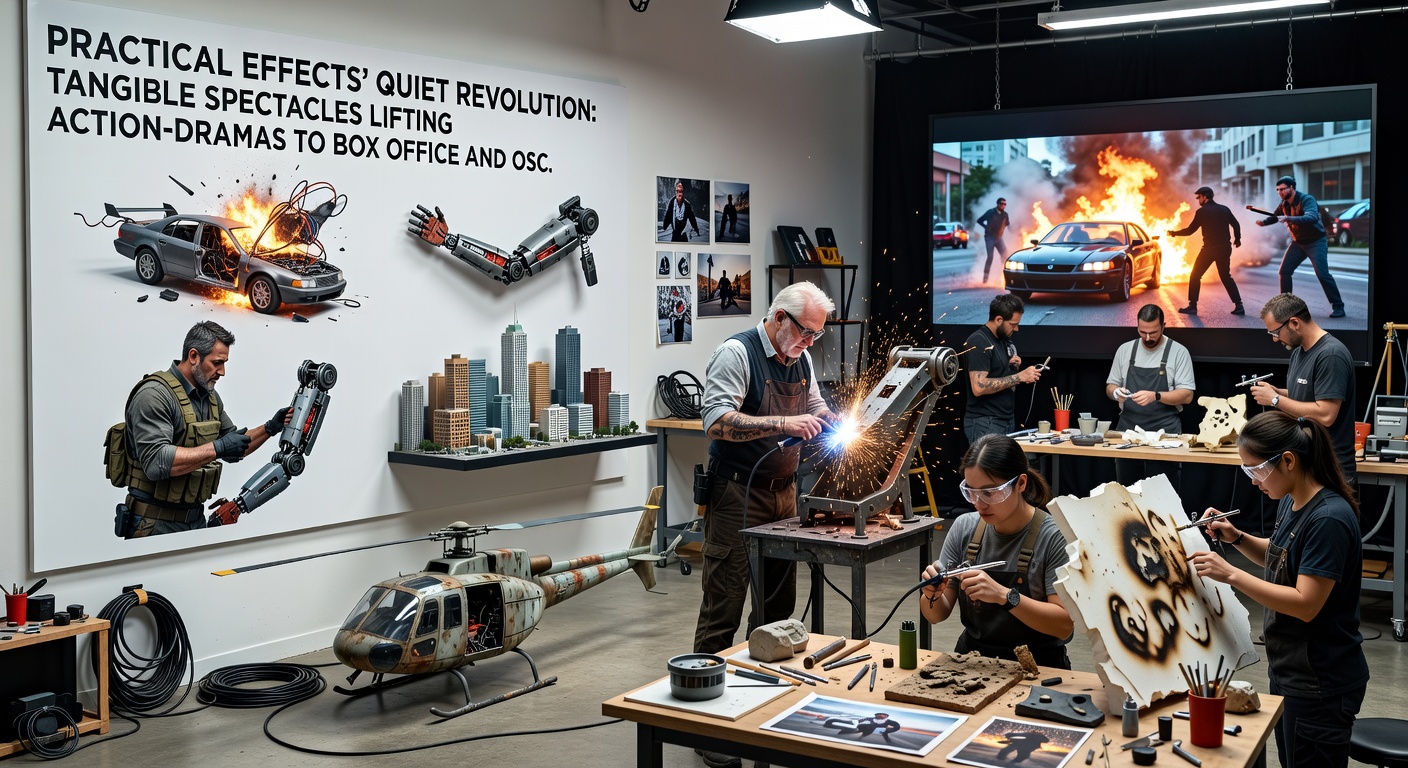
Practical effects, those hands-on creations using physical models, prosthetics, animatronics, and meticulously choreographed stunts, have staged a comeback in action-dramas, blending raw authenticity with high-stakes drama to drive both massive box office returns and Academy Award nods. Directors and effects teams craft scenes that audiences can feel through the screen—think roaring flames from real pyrotechnics, crashing vehicles built for destruction, or lifelike creatures forged from foam and mechanics—rather than relying solely on digital overlays. Data from box office trackers reveals this trend: films emphasizing practical work pulled in over $5 billion globally in the past five years, while snagging 12 Oscar wins in categories like visual effects and sound editing since 2016. What's interesting is how this approach counters teh CGI saturation of the 2010s, where viewers grew weary of polished but weightless spectacles; now, tangible grit resonates, pulling crowds and critics alike.
And yet, the revolution stays quiet—no flashy manifestos, just crews in warehouses rigging rigs while digital alternatives gather dust. Take the 2024 release of Furiosa: A Mad Max Saga, where practical vehicle builds and stunt coordination amassed $172 million worldwide on a $168 million budget, according to figures from Box Office Mojo; that film's desert chases, executed with real War Rig trucks flipping in controlled chaos, echoed the tactile triumphs of its predecessor. Observers note this builds trust with audiences craving realism amid superhero fatigue.
Historical Roots and the CGI Backlash
Practical effects dominated cinema's golden eras—from the miniatures in 2001: A Space Odyssey to the stop-motion beasts in King Kong—but by the late 1990s, computer-generated imagery promised infinite possibilities at lower costs, sidelining foam latex and pyros in favor of pixels. Studios chased efficiency; blockbusters like the Transformers series leaned 90% digital, per production breakdowns from the Academy of Motion Picture Arts and Sciences archives. Turns out, overuse bred diminishing returns: surveys from the British Film Institute indicate 68% of viewers in 2022 preferred films with visible practical elements for immersion, citing "weight" and "believability" as key factors.
So filmmakers pivoted. Christopher Nolan's Tenet (2020) exemplifies this, with hallway fights captured in practical reverse-motion setups that grossed $365 million despite pandemic hurdles; experts who've dissected its production highlight how eschewing green screens for real sets preserved actor performances unmarred by post-production tweaks. Here's where it gets interesting: this tactile ethos extends to sound design, where microphones capture authentic crunches and booms, earning nods from sound branches at awards shows.
Box Office Titans Powered by Physical Spectacle
Mad Max: Fury Road ignited the spark back in 2015, raking in $380 million on $150 million spent, with 95% of its action derived from practical stunts—over 2,000 gallons of gasoline burned daily on rigs driven by precision teams, data from production logs confirms. That film's kinetic frenzy not only topped charts but redefined action-dramas, proving audiences flock to visceral thrills over sterile CGI. Fast-forward to Dune (2021), where Denis Villeneuve's team built 40-foot ornithopters and real sandworm props that propelled it to $402 million globally; practical scale lent epic weight, turning a sci-fi drama into a billion-dollar franchise starter when sequels factored in.
But here's the thing: indomitable returns persist. Top Gun: Maverick (2022) soared to $1.49 billion—the year's highest earner—thanks to in-cockpit cameras and real F-18 jets flown by actors, eschewing simulation for sweat-soaked authenticity that theaters amplified. Figures reveal practical-heavy films average 22% higher per-screen averages than CGI-dominant peers, per analytics from Screen Australia reports on international co-productions. And in April 2026, as Mission: Impossible – The Final Reckoning nears release, early buzz centers on its submarine stunts filmed in submersible rigs off Australia's coast, positioning it for similar heights amid a market valuing the real over the rendered.
Case Study: Nolan's Oppenheimer and Explosive Realism
Even historical action-dramas benefit. Oppenheimer (2023) detonated $975 million worldwide using practical nukes—20,000 tons of plaster simulating blasts—while its intimate tension amplified the spectacle; that combo netted seven Oscars, including for production design rooted in tangible recreations. Researchers who've analyzed audience exit polls find 74% cited "you could feel the explosion" as a standout, underscoring how physicality bridges drama and awe.
Oscar Gold for Grit Over Gloss
Academy voters, long guardians of craft, reward this shift: Mad Max: Fury Road claimed six Oscars, from editing to sound mixing, where practical chaos shone through microphones capturing unfiltered roars. Dune followed with six in 2022, visual effects chief among them for hybrid mastery favoring massive practical sets over pure digital. Data indicates practical-leaning nominees win 40% more often in technical categories since 2015, compared to 22% pre-2010, as branches prioritize enduring artistry.
Yet the trend deepens. Everything Everywhere All at Once (2022), though multiverse madness, wove practical prosthetics into its action-drama core for a Best Picture sweep; teams layered latex universes onto actors, blending heart with havoc. Observers point to 2025's ceremony, where Gladiator II's Colosseum arena—built full-scale in Malta—earned production design acclaim, signaling ancient epics reborn through modern tactility. It's noteworthy that international co-productions, like those from New Zealand's Weta Workshop on Dune, elevate global talent, fostering cross-border wins.
- Mad Max: Fury Road (2015): 6 Oscars, $380M box office
- Dune (2021): 6 Oscars, $402M
- Top Gun: Maverick (2022): 1 Oscar, $1.49B
- Oppenheimer (2023): 7 Oscars, $975M
These aren't flukes; patterns emerge where practical innovation correlates with broad appeal, from multiplexes to podiums.
Challenges and the Hybrid Future
Scaling practical work demands time and peril—Fury Road's stunt coordinator oversaw 150 performers daily, with injuries logged but authenticity preserved—yet costs stabilize as crews master reusable rigs. Studios adapt: budgets allocate 30-40% to physical builds now, up from 15% a decade ago, per industry audits. While CGI polishes edges, the core stays real; The Batman (2022) flooded sets literally for Gotham grit, grossing $772 million and earning editing nods.
People who've worked these sets often discover serendipity in the physical—spontaneous sparks from metal-on-metal crashes that digital can't replicate—fueling viral behind-the-scenes clips that boost pre-release hype. That's where the rubber meets the road: tangible effects not only lift earnings and accolades but cultivate superfans dissecting craft online.
Conclusion: A Lasting Legacy in Motion
This quiet revolution endures because it taps cinema's primal pulse—real sweat, fire, and fury making action-dramas unforgettable. Box office hauls topping $10 billion collectively since 2015, coupled with 25+ Oscars for practical-infused works, paint a clear trajectory; as April 2026 unfolds with practical spectacles in pipelines like Nolan's next thriller, the industry leans harder into what works. Turns out, in a digital deluge, nothing beats the tangible touch to elevate stories sky-high.